TheFugitive

TheFugitive

Wednesday, November 28, 2012

Cholesterol Doesn't Cause Heart Disease


In last week’s article about the ineffectiveness of statin drugs in reducing mortality in most populations I promised I would follow-up with an article on drug-free prevention of heart disease. I will do that this week, but it occurred to me that the first article in this series should have been one that dispels the myth that cholesterol causes heart disease. Understanding that is the key to the prevention strategies that will follow in the next article. So without further ado…
butterYou are all no doubt acquainted with the popular hypothesis on cholesterol and heart disease. It has two parts: first, that eating cholesterol in the diet raises cholesterol levels in the blood; and two, that high cholesterol levels in the blood cause heart disease.
You might be surprised to learn that neither of these statements is true. The first one is relatively easy to dispatch. In the Framingham Heart Study, which is the longest-running and perhaps most significant study on heart disease done to date, it was demonstrated that intake of cholesterol in the diet had absolutely no correlation with heart disease. If you look at the graph below, you’ll see that both men and women with above average intake of cholesterol had nearly identical rates of heart disease as men and women with below average intake of cholesterol.
framingham
In fact, the “diet-heart hypothesis”, which is the scientific name for the idea that eating cholesterol causes heart disease, has even been discounted by the researchers who were responsible for its genesis. Ancel Keys, who in many ways can be considered the “father” of the cholesterol-heart disease hypothesis, had this to say in 1997:
“There’s no connection whatsoever between the cholesterol in food and cholesterol in the blood. And we’ve known that all along. Cholesterol in the diet doesn’t matter at all unless you happen to be a chicken or a rabbit.”
This is a reference to early studies performed on chickens and rabbits where they force-fed these animals high-levels of cholesterol. Since rabbits and chickens are mostly vegetarian, their physiology is not adapted for processing such large amounts of dietary cholesterol, so it’s no surprise they developed atherosclerosis. The mistake was assuming that the results of this experiment could be extrapolated to humans, who are omnivores with significant differences in physiology.
The second tenet of the cholesterol-heart disease hypothesis, the notion that high cholesterol levels in the blood cause heart disease, is referred to as the “lipid hypothesis” in the scientific community. Though it still accepted as gospel truth by the general public and many medical professionals, most researchers now believe the primary causes of heart disease are inflammation and oxidative stress. Unfortunately, the rest of us haven’t gotten the memo, so to speak, that cholesterol isn’t the cause of heart disease.
It would take several articles to explain this in complete detail, but I’d like to give at least a brief summary here.
If cholesterol caused heart disease, it should be a risk factor in 1) all ages, 2) both sexes and 3) all populations around the world (barring any protective factor, of course). Also, if cholesterol caused heart disease we would expect that lowering cholesterol would reduce heart disease. But none of these assumptions turn out to be true.
The rate of heart disease in 65-year old men is ten times that of 45-year old men. Yet a recent study in the Journal of American Medical Association indicated that high LDL cholesterol is not a risk factor for from coronary heart disease (CHD) mortality or total mortality (death from any cause). It is extremely unlikely that a risk factor for a disease would stop being a risk factor at a time when that disease kills the greatest number of people. That is akin to suggesting that smoking causes lung cancer in young men, but somehow stops doing so in older men!
Another consistent thorn in the side of supporters of the “lipid hypothesis” is that women suffer 300% less heart disease than men, in spite of having higher average cholesterol levels. At the recent Conference on Low Blood Cholesterol, which reviewed 11 major studies including 125,000 women, it was determined that there was absolutely no relationship between total cholesterol levels and mortality from cardiovascular or any other causes.
Nor is cholesterol a risk factor in all populations around the world. In fact, some of the populations with the highest levels of blood cholesterol have among the lowest rates of heart disease, and vice versa. Dr. Malcom Kendrick, a well-known skeptic of the lipid-hypothesis, explains this very well in the video below:
Finally, more than 40 trials have been performed to determine whether lowering cholesterol levels can prevent heart disease. In some trials heart disease rates went down, in others they went up. But when the results of all of the trials were taken together, just as many people died in the treatment groups (who had their cholesterol levels lowered by drugs) as in the control groups (who had no treatment).
If you’re still skeptical after reading all of this, perhaps William Castelli, the director of the famed Framingham Heart Study mentioned above can convince you:
“Serum cholesterol is not a strong risk factor for CHD, in the sense that blood pressure is a strong risk factor for stroke or cigarette smoking is a risk factor for lung cancer.”
Or how about Frederick Stare, a long-time American Heart Association member and (former) proponent of the lipid hypothesis:
“The cholesterol factor is of minor importance as a risk factor in CVD. Of far more importance are smoking, hypertension, obesity, diabetes, insufficient physical activity, and stress.”
So there you have it. Contrary to popular belief, cholesterol is not a dangerous poison that causes heart disease. Rather, it is an essential nutrient present in the cell membranes of all tissues of all mammals, and has some very important functions in the body. In fact, in many studies low cholesterol has been associated with an increase in total mortality!
Again, the Framingham Study which followed 15,000 participants over three generations:
“There is a direct association between falling cholesterol levels over the first 14 years and mortality over the following 18 years.”
In other words, as cholesterol fell death rates went up.
The Honolulu Heart Program study, with 8,000 participants, published in 2001:
“Long-term persistence of low cholesterol concentration actually increases the risk of death. Thus, the earlier the patients start to have lower cholesterol concentrations, the greater the risk of death.”
And finally, the huge Japanese Lipid Intervention Trial with over 47,000 participants:
“The highest death rate observed was among those with lowest cholesterol (under 160mg/dl); lowest death rate observed was with those whose cholesterol was between 200-259mg/dl”
In other words, those with the lowest cholesterol had the highest death rate, and those with cholesterol levels that would today be called “dangerous” had the lowest death rate.
As you can see, not only does high cholesterol not cause heart disease, low cholesterol can actually be dangerous to your health. So toss out your vegetable oil and start eating butter and eggs again! But more on that next week…

Tuesday, November 27, 2012

Depression Treatment with Dopamine


Scientists' understanding of depression and its causes has changed significantly over the past 20 years. Recent advances in drug therapy that address neurotransmitter deficiencies have improved the quality of life for innumerable patients. Furthermore, new medications have far fewer side effects than older agents. However, no medication is completely free from adverse effects, so many people, particularly those with milder depression, turn to alternative remedies. If you suffer from depression, you may have considered boosting the dopamine levels in your brain, although this approach has not been proven to cure depression.

Dopamine Deficiency Linked to Depression
Dopamine is a neurotransmitter, or chemical messenger, that is found in your brain and many other organs. Dopamine relays impulses across the microscopic spaces, called synapses, which exist between adjacent nerves, thus allowing the propagation of messages from one nerve to the next. A deficiency of dopamine activity in the brain has been strongly linked to depression. In fact, a 2010 review in "Frontiers in Neuroscience" suggests "all antidepressant treatments have a common, final, dopaminergic" pathway and that a person's response to an antidepressant medication is ultimately dependent on stimulation of dopamine receptors.


Tyrosine Improves Brain Function
Unlike dopamine, L-tyrosine and L-dopa, which is dopamine's immediate precursor, can both cross the "blood-brain barrier." Thus, the consumption of more L-tyrosine would presumably lead to higher dopamine levels in your brain. A 2007 study in "Physiology and Behavior" shows that supplemental tyrosine improves mental performance under conditions of physiologic stress, lending support to the notion that boosting tyrosine levels also boosts neurotransmitter levels.


Considerations
According to "CNS Neuroscience and Therapeutics," several prescription antidepressant medications are known to increase brain dopamine levels, as well as the levels of dopamine's relatives, epinephrine and norepinephrine. Thus, dopamine's role in the evolution and treatment of depression is well-established. However, dopamine's precursors, specifically L-tyrosine and L-dopa, have not been proven to be useful for treating depression. If you think you might benefit from increasing your own dopamine levels, talk to your physician.


Nicole Wilkins Calorie Blasting Boxing Workout

By Muscle & Fitness

Boxers and mixed martial artists are among the best-conditioned athletes on the planet. That's because their workouts combine strength, speed, stamina, balance, agility, and focus. Result: a knockout body that's lean and sculpted.
We asked IFBB figure pro Nicole Wilkins to demonstrate some of her favorite boxing and kickboxing moves in a fat-blasting workout designed by mixed martial arts strength and conditioning coach Rob Fletcher, founder of America's Next Great Trainer.


Warm-Up ///
(About 10-15 minutes)
Do each of the following drills for 30-60 seconds; when you finish all three, you've done one round. Complete 3-5 rounds.
Jump Rope: Either with a real rope or an imaginary one, jump in place. Can do regular jumps with feet together, alternate the left foot and right foot, bring heels to butt, or lift knees high while jumping.
Jumping Jacks: Fully extend arms and legs.
Jog In Place: Stand tall and bring knees toward hips.


Shadow Box ///
(About 3 minutes)
Maintain form throughout each punch (see "Boxing Glossary" below). Do all punches in a boxer's stance.
  1. Jab
  2. Jab, then jab again (same arm)
  3. Jab, cross (optional: add whipping/direct elbow or knee-up)
  4. Jab, cross, uppercut (optional:add knee-up)
  5. Jab, cross, front hook
  6. Back hook, lead uppercut, cross


Main Workout ///
(About 18-24 minutes)
  1. Cardio Round: Jump Rope (see warmup for different types of jumps)
  2. Boxing Round: Repeat Shadow Box workout, focusing on speed and intensity.
  3. Strength & Conditioning Round: Do 5 reps of each exercise until the round is over.
    • Burpees: Stand tall, then squat down, placing hands on floor; jump legs back to full push-up position, hold one count, then jump legs back to start; stand up and repeat.
    • Prisoner Squats: Stand with feet about shoulder-distance apart, hands behind head with elbows out to sides. Squat down, keeping hands in place; don't lean forward. Push up through heels to return to start and repeat
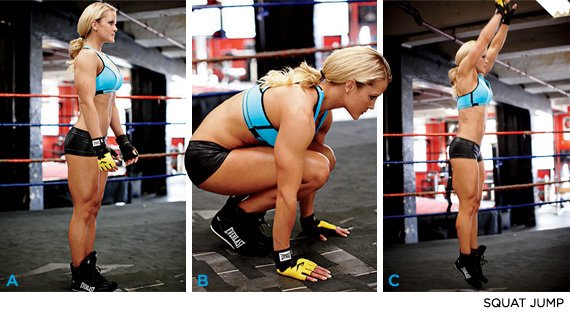
    • Squat Jumps: Stand with hands at sides, knees slightly bent. Jump up, landing in a squat; keep weight over heels and chest upright; use arms to help you counterbalance. Immediately go into the next jump; repeat.
  4. Combinations: Repeat Shadow Box workout, focusing on speed and intensity. You can switch your lead foot in this round.
  5. Repeat Strength & Conditioning Round: (burpees, prisoner squats, squat jumps, push-ups)
  6. Combinations: Repeat Shadow Box workout, focusing on speed and intensity.


Cool Down ///
(About 2 minutes)
Finish your workout by doing a jab, cross, hook, and uppercut combination, 5 reps per side. Focus on your technique, moving slowly through the full range of motion.


Road Work ///
Boxers burn fat and increase their stamina by performing high-intensity speed intervals. Try it for yourself on one of your non-boxing training days (either outside or on a treadmill) to get that lean look.
  • Jog: Maintain an easy, comfortable pace (20 minutes).
  • Sprint Drills: Run as fast as you can for about 1/8 of a mile, then rest for 1 minute. Repeat 5-6 times.
  • Walk or Jog: To cool down (5 minutes).


Boxing Glossary

Boxing and kickboxing have their own vocabulary to describe the punch and kick styles that turn you into a well-balanced fighter. Here's what you need to know:
Boxer's Stance ///
Stand with one foot back, feet shoulder-width apart, back heel aligned with front toes, toes pointed out 45 degrees, and body turned slightly sideways. Keep your weight evenly distributed on the balls of both feet, knees slightly bent, hands at eye level with wrists straight, chin slightly tucked into shoulder, and elbows pulled tight into body.
Punching Power ///
  • Jab: Punch with lead hand, making point of impact with the knuckles of your pointer and middle fingers. As you punch, turn hips while pivoting on lead foot, keep opposite hand up near chin to protect head and face.
  • Cross: Punch with the back hand, making the point of impact with the two big knuckles. As you punch, turn hips in the direction you are moving while pivoting on back foot. Keep opposite hand up to protect head and face.
  • Front or Back Hook: Transfer body weight to lead leg and punch across body with lead hand, turning hips in the direction you are punching. Your lead arm moves parallel to floor with elbow bent about 90 degrees. Keep opposite hand up to protect head and face. For back hook punch, transfer body weight to back leg and punch across body with back arm parallel to floor, turning hips in the direction you are punching.
  • Uppercut: Transfer weight to front foot and slightly dip front shoulder, putting pressure on balls of feet. As you punch, prepare to launch and explode upward, rotating hips in the direction you are punching while pivoting on balls of feet. Keep punching elbow tight to body. You can punch in or up (palm up), depending on the target area (i.e., solar plexus, ribs, jaw, or kidneys). Opposite hand remains up near chin to protect head and face.
  • Knee-Up: From boxer's stance, thrust hips forward, driving back knee straight up and in; lower back to boxer's stance.
  • Whipping/Direct Elbow: Move back hand as if throwing a hook punch, but keep elbow in front and hand close to body. Whip back elbow across front of your body to target area. Immediately after throwing whipping elbow, lunge forward and drive the same elbow straight into target.

Monday, November 26, 2012

Win 2 tickets to UFC 155


Powered By Gamma Labs

Team Gamma Darren Dugan will be Sporting a New Gamma Belt


What to Eat Before During and After your Workout


By Matt Bliss
At this point, you should know that nutrition has a significant impact on your results. Abs are built in the kitchen, you are what you eat, and all the rest. "Yeah, yeah," you mutter, "I've heard it all before."
Seriously, though: You might be wreaking utter havoc in the gym, but research indicates that what you eat before, during, and after your workout may be the difference between meeting your goals and falling short.
Here's how to harness the power of peri-workout nutrition so you can perform, recover, and grow faster than a weed.

Nutrition Before Your Workout

Carbohydrates ///

There are few things in the fitness world that incite more arguments and controversy than carbohydrates. Will they make you fat? Do you need them? What kind? At what times? The questions seem endless. There are varying approaches, but if you want to get the most from your workouts and train at your peak, quality fuel is critical.
Carbohydrates are your body's preferred fuel source. I'm not saying you should plow through plates of mashed potatoes and chomp candy bars all day, but you need to fuel your body so it can train at its best.
You want every gram of carbohydrate you consume to be utilized as an immediate fuel source or to restore glycogen levels—you don't want it to be stored as fat. Don't eat more carbs than you need and don't worry about spreading them evenly throughout the day. You can eat the majority of your carbs around your workout.
I like clients to have at least two meals under the belt before training. Your first two meals should include complex carbohydrates like stone-rolled oats or sweet potatoes. Your first meal will provide a couple hours for carbs to get digested and go to work, ensuring blood sugar levels are up and glycogen levels are full
prior to training.
Consume your second meal roughly one hour before lifting. Don't get worked up about counting the minutes and seconds, as if five minutes will be the difference between 17- and 18-inch arms. Do the best you can, and try to time it so you can begin training without a lot of food in your gut—running to the garbage can to yak just isn't fun. Most people can benefit from 40 grams of carbs before they train.
Fast-Absorbing Protein ///
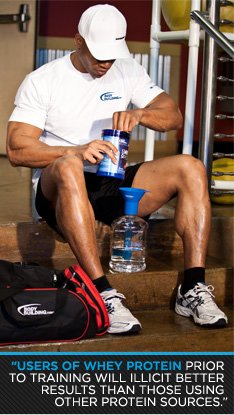
Research has indicated that users of whey protein prior to training will illicit better results than those using other protein sources (or none at all). This is most likely due to the anti-catabolic and anabolic signaling effects of the branched-chain amino acids (BCAAs) present in whey protein—particularly leucine. Whey has a considerably higher concentration of BCAAs than other proteins.

There are many other benefits, as well. Studies have shown that pre-workout protein intake will increase resting energy expenditure by an average of 6-6.5% for up to 48 hours1. Pre-workout protein will also blunt cortisol through the day, an effect that wasn't seen in control groups that were fasted or had ingested carbs only.
Protein and amino acids also spare carbs. People often assume that when the body runs out of carbohydrate fuel, it switches to fatty acids for fuel. That process is typically too slow for high-intensity training. To provide fuel more quickly, amino acids are rapidly broken down and converted to sugar in a process known as gluconeogenesis. If those amino acids aren't in the blood supply, guess where they come from? Yep, your 18-inch biceps. For those of us who are dieting, some extra aminos in our bloodstream may help preserve our lean mass.
Now some of you heavy macro-counters may have reservations about consuming protein pre-workout, especially if you are dieting down. If that's the case, use 10-15 grams of BCAAs instead.
This should provide similar effects and elevate net protein synthesis. Pre-workout BCAAs may even help low-carb dieters burn more fat.2
Creatine Monohydrate ///
For people with strength or hypertrophy goals, consider supplementing with creatine monohydrate. While there are many forms of creatine available, I prefer micronized creatine monohydrate because it's the most studied, solid, tried-and-true creatine on the market.
The body has three primary methods for developing its ultimate energy source, ATP. Which method your body uses depends on the intensity of the activity. For the most intense activities—like weightlifting—the body uses creatine phosphates to produce energy.
Creatine supplementation of 2-5 grams per day will provide greater stores to call on when training, enabling you to train more intensely. In short, creatine can help you train heavier for more reps; it also draws water into the muscles, making you look "full" in appearance.
The timing on the creatine is not critical. You can use it before or after your workout, or anytime throughout the day. If you've been using creating for a while, 2-5 grams once per day will do the trick. If you just started taking creatine monohydrate, you can "load" your muscles with 20-30 grams of creatine per day for 4-5 days.
Creatine Monohydrate

CREATINE 


MONOHYDRATE

Creatine helps provide energy to 
complete each and every muscular contraction.* Creatine can be the driving force behind your workouts.*
Get your Creatine Monohydrate today
Beta Alanine ///
Basically, beta alanine helps conserve muscular energy. One of the main causes of fatigue is intramuscular acidosis. When your body produces ATP using the glycolytic and phosphagen systems, the result is metabolic byproducts like excess hydrogen ions. When these hydrogen ions are not cleared fast enough, they bind with pyruvate to produce lactic acid, and elevated levels have been shown to hinder performance, coordination, and skill.
The body can use the L-carnosine to correct this imbalance. L-carnosine is formed from the amino acids L-histidine and beta-alanine. In addition to decreasing hydrogen ion production, it acts as an antioxidant. The limiting factor in carnosine production is the availability of beta-alanine. Research has demonstrated that supplementation can increase muscle carnosine content, eliciting improvements in high-intensity athletes.
This also applies to endurance athletes. The most recent research indicates that the optimal dose of beta-alanine is 4-5 grams3. Ideally, the dosage should be spread throughout the day, but 800 mg should come just before a training session.

Nutrition During Your Workout

Most people don't train long enough per session to need additional fuel while they train, especially if they've hit their pre-workout nutrition needs. Depleted dieters, like people preparing for physique competition, may benefit from extra fuel. One of the primary concerns for physique athletes is muscle loss as they whittle down to mid-single-digit body-fat levels. In this state, protein turnover is increased; your body actually needs more protein in a depleted state than it does when you're trying to gain muscle.
In this scenario, branched chain amino acids are a great intra-workout supplement. The amino acids provide some protection from catabolism for those folks in drastic conditions. It probably wouldn't hurt a physique athlete to keep additional BCAAs flowing throughout the day. Increased blood amino acid levels during training may also help elevate net protein synthesis.
Athletes who have unusually long training sessions or burn up extreme amounts of energy may also need intra-workout fuel. This isn't the majority, mind you. Most people drinking Gatorade don't actually need extra fuel for their five-minute warm-up and six-machine training routine. Extra workout fuel is necessary for people who train at a high intensity for well beyond an hour.
An intra-workout cocktail for these individuals should include water, electrolytes, BCAAs (orhydrolyzed protein), and carbohydrates. There are other possibilities, but this is a solid baseline.

Nutrition After Your Workout

Protein ///
Protein is essential for tissue growth and repair. Since the body is continuously breaking down proteins, our diet must provide sufficient quantities. Although recommended intakes vary and depend on body size and activity, a post-workout protein is almost universally helpful to kickstart muscle repair, recovery, and growth.

Whey protein is incredibly popular because it is rich in BCAAs, digests quickly, is highly bio-available, and has a perfect Protein Digestibility Corrected Amino Acid Score. While whey is excellent after a workout, recent research suggests that a combination of fast- and slow-digesting proteins—like whey and casein—may provide the ultimate post-workout protein cocktail.4
Most sources agree that at least 20 grams of whey is necessary to boost muscle repair and recovery.5 Hydrolyzed whey protein may spike blood amino acid levels faster than regular whey, but won't provide a long-term protein source. To cover your bases, consume a shake containing 40 grams of mixed protein (whey and casein) after your workouts.
BCAAs ///
In cases of calorie restriction or during periods of long or intense exercise, catabolism of muscle tissue could occur when glycogen and blood sugar are not present in sufficient quantities to fuel activity. Amino acids via dietary protein become very important for any athlete. This is especially true of BCAAs (leucine, isoleucine, and valine), which studies have shown muscles prefer as a source for fuel.6
I've included BCAAs after training for the same basic reasons I included them earlier: You can't really do any wrong—unless you decide to drink the entire container in one sitting—and you may provide a fast boost to blood amino levels. I recommend 10 grams of BCAAs after your lifting session, especially if you are in a caloric deficit.
Fast Carbs (Optional) ///
After a tough workout, your fuel of blood sugar and glycogen should be low. You may have even tapped into reserves to complete your training, especially if you are dieting. Most of us understand the need for protein after training, but many overlook the benefits of fast-acting carbohydrates.
From a physiological perspective, your body's first priority is correcting blood sugar balance and replenishing glycogen, not making your biceps pop. Consume fast-digesting carbohydrates in order to spare protein, replenish glycogen, spike insulin, and speed recovery. Dose recommendations differ, but to maximize recovery, ingest 50-75 grams of high-glycemic carbs after exercise.